Similar question wording is grouped and ranked by the number of distinct exam sessions. Groups with the same count are ordered by their extracted text. Some subjects have only one session. Paper references show the PDF page and extracted question number when available.
Module 1
Expand exsiny in powers of x and y up to terms of third degree using Maclaurin's series.
View question scan & diagrams1 exam session
Dec 2025/Jan 2026 · PDF page 1
Find the total derivative when u=x3y2+x2y3, where x=at2 and y=2at.
View question scan & diagrams1 exam session
Dec 2025/Jan 2026 · PDF page 1
If u=log(tanx+tany+tanz), show that sin2x∂x∂u+sin2y∂y∂u+sin2z∂z∂u=2.
View question scan & diagrams1 exam session
Dec 2025/Jan 2026 · PDF page 1
Show 2 Backup Questions
(b) If u=f(yx,zy,xz), prove that x∂x∂u+y∂y∂u+z∂z∂u=0.
(c) Examine the function f(x,y)=x3+3xy2−15x2−15y2+72x for extreme values.
View question scan & diagrams1 exam session
Dec 2025/Jan 2026 · PDF page 1
If u=x+y+z, v=x2+y2+z2 and w=xy+yz+zx, evaluate the Jacobian of (u,v,w) with respect to (x,y,z).
View question scan & diagrams1 exam session
Dec 2025/Jan 2026 · PDF page 1
Module 2
Find the directional derivative of ϕ=x2yz+4xz2 at (1,−2,−1) in the direction 2^−^−2k^.
View question scan & diagrams1 exam session
Dec 2025/Jan 2026 · PDF page 1
Given F=∇(xy3z2), find divF and curlF at (1,−1,1).
View question scan & diagrams1 exam session
Dec 2025/Jan 2026 · PDF page 1
Show that F=(y+z)^+(z+x)^+(x+y)k^ is irrotational and find the scalar potential.
View question scan & diagrams1 exam session
Dec 2025/Jan 2026 · PDF page 1
Show 2 Backup Questions
(b) Show that F=x2+y2x^+y^ is both solenoidal and irrotational.
(c) Express 2y^−z^+3xk^ in spherical polar coordinates.
View question scan & diagrams1 exam session
Dec 2025/Jan 2026 · PDF page 1
With usual notation, prove that the cylindrical polar coordinate system is orthogonal.
View question scan & diagrams1 exam session
Dec 2025/Jan 2026 · PDF page 1
Module 3
4 distinct question groups available in the collected papers. More exam sessions are being collected.
Find the eigenvalues and eigenvectors of A=113151311.
View question scan & diagrams1 exam session
Dec 2025/Jan 2026 · PDF page 2
Find the rank of A=1332634123396.
View question scan & diagrams1 exam session
Dec 2025/Jan 2026 · PDF page 2
Investigate the values of μ and λ for which the equations x+y+zx+2y+3zx+2y+λz=6=10=μ have (i) a unique solution, (ii) infinitely many solutions, or (iii) no solution.
View question scan & diagrams1 exam session
Dec 2025/Jan 2026 · PDF page 2
Show 1 Backup Question
Using Gaussian elimination, solve x+2y+z2x+3y+3z3x−y+2z=3=10=13.
View question scan & diagrams1 exam session
Dec 2025/Jan 2026 · PDF page 2
Module 4
4 distinct question groups available in the collected papers. More exam sessions are being collected.
Define an inner product space. Given u=(1,2,4), v=(2,−3,5) and w=(4,2,−3) in R3, find (i) ⟨u,v⟩, (ii) ⟨v,w⟩, (iii) ⟨u,w⟩, (iv) ∥u∥ and (v) ∥v∥.
View question scan & diagrams1 exam session
Dec 2025/Jan 2026 · PDF page 2
Find the basis and dimension of the row space, column space and null space of 120−1−1111−135−121−3.
View question scan & diagrams1 exam session
Dec 2025/Jan 2026 · PDF page 2
Find the basis and dimension of the subspace spanned by (2,4,2), (1,−1,0), (1,2,1) and (0,3,1) in V3(R).
View question scan & diagrams1 exam session
Dec 2025/Jan 2026 · PDF page 2
Show 1 Backup Question
What is a subspace? Prove that the subset W={(x,y,z)∣x−3y+4z=0} of the vector space R3 is a subspace.
View question scan & diagrams1 exam session
Dec 2025/Jan 2026 · PDF page 2
Module 5
3 distinct question groups available in the collected papers. More exam sessions are being collected.
Find the matrix representing the linear transformation T:R3→R4 defined by T(x,y,z)=(x+y+z,2x+z,2y−z,6y).
View question scan & diagrams1 exam session
Dec 2025/Jan 2026 · PDF page 3
(b) Prove that T:R2→R2, defined by T(x,y)=(2x+4y,x+2y), is singular and find its kernel.
(c) Verify the rank–nullity theorem for T:R3→R3, defined by T(x,y,z)=(x+2y,y−z,x+2z).
View question scan & diagrams1 exam session
Dec 2025/Jan 2026 · PDF page 3
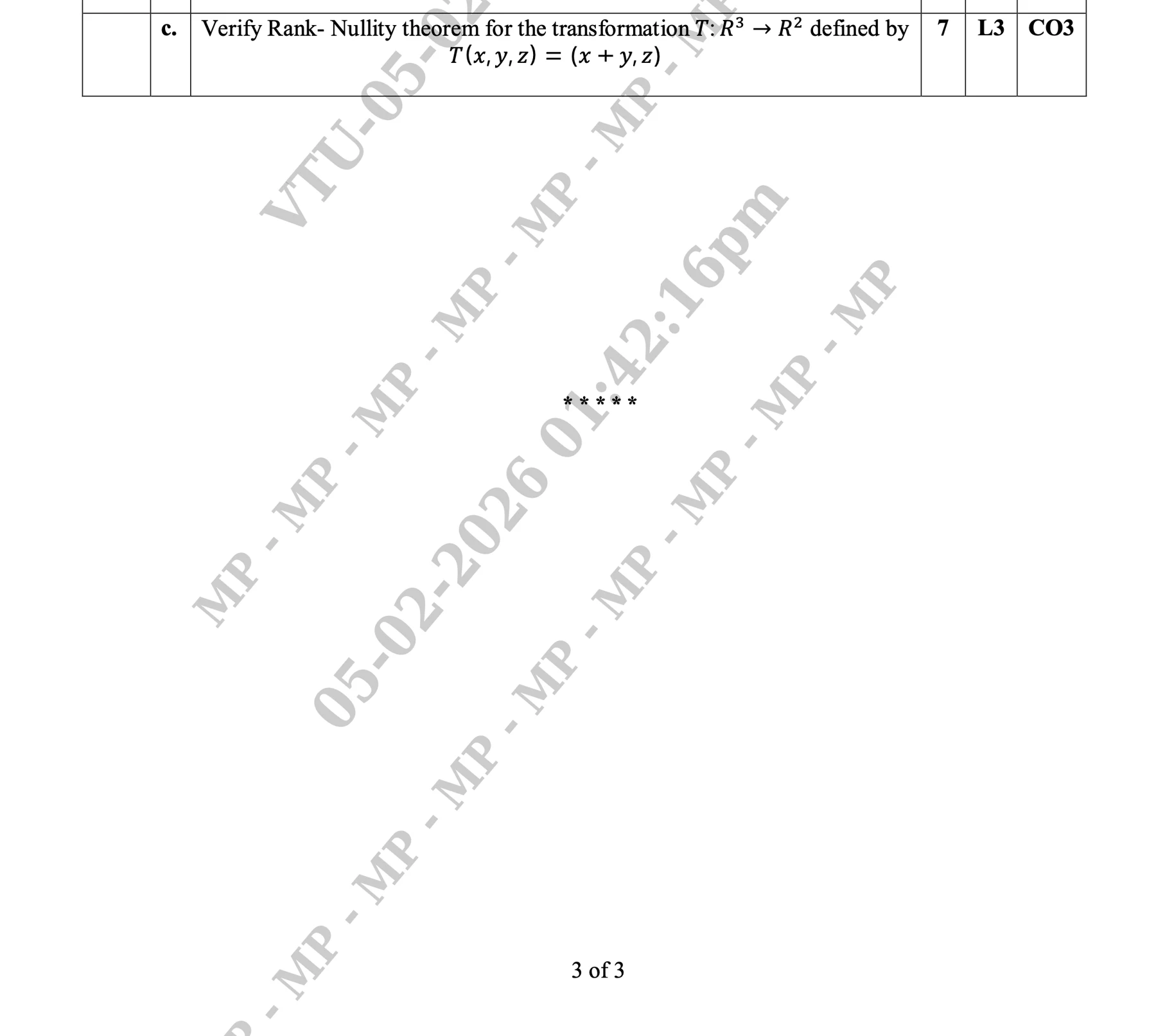
Verify the rank–nullity theorem for T:R3→R2, defined by T(x,y,z)=(x+y,z).