Similar question wording is grouped and ranked by the number of distinct exam sessions. Groups with the same count are ordered by their extracted text. Some subjects have only one session. Paper references show the PDF page and extracted question number when available.
Module 1
Change the order of integration and hence find Jo Jo x y2 dy dx
OCR transcription · Wording, symbols, or figures may be incomplete.
View question scan & diagrams1 exam session
June/July 2026 · PDF page 1
Find J, So x+2(x + y + z) dxdydz
OCR transcription · Wording, symbols, or figures may be incomplete.
View question scan & diagrams1 exam session
June/July 2026 · PDF page 1
Find Jo' Jo e-(x +y') dx dy by changing to polar coordinates
OCR transcription · Wording, symbols, or figures may be incomplete.
View question scan & diagrams1 exam session
June/July 2026 · PDF page 1
Show 2 Backup Questions
Find the area between the parabolas y2 = 4ax and x2 = 4ay using double
integral.
OCR transcription · Wording, symbols, or figures may be incomplete.
View question scan & diagrams1 exam session
June/July 2026 · PDF page 1
Show that B(m, n) = I(m) I(n)
T(m+n)
OCR transcription · Wording, symbols, or figures may be incomplete.
View question scan & diagrams1 exam session
June/July 2026 · PDF page 1
Module 2
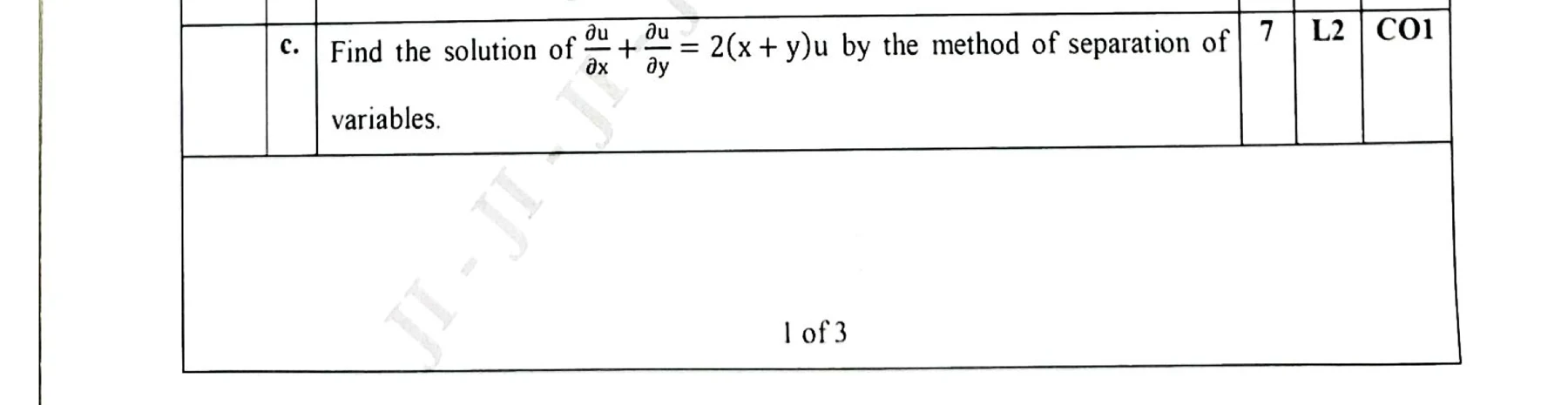
= 2(x + y)u by the method of separation of
Find the solution of u
variables.
OCR transcription · Wording, symbols, or figures may be incomplete.
View question scan & diagrams1 exam session
June/July 2026 · PDF page 1
Derive of one-dimensional heat equation.
OCR transcription · Wording, symbols, or figures may be incomplete.
View question scan & diagrams1 exam session
June/July 2026 · PDF page 1
Form a partial differential equation by eliminating the arbitrary functions
f and g from the relationz = f(x + ay) + g(x - ay)
OCR transcription · Wording, symbols, or figures may be incomplete.
View question scan & diagrams1 exam session
June/July 2026 · PDF page 1
Show 2 Backup Questions
Form a partial differential equation of the family of sphere
(x - a)½ + (y - b)½ + z? = r2 by eliminating arbitrary constants.
OCR transcription · Wording, symbols, or figures may be incomplete.
View question scan & diagrams1 exam session
June/July 2026 · PDF page 1
Solve - = sinx siny for which y = -2siny, when x = 0 and z =
when y = (2n + 1) ½
OCR transcription · Wording, symbols, or figures may be incomplete.
View question scan & diagrams1 exam session
June/July 2026 · PDF page 1
Module 3
Find the constants a, b, c so that vector function F = (x + 2y + az)i +
(bx - 3y - z)j + (4x + cy + 2z)k is irrotational. Hence find scalar
potential o such that F = VQ
OCR transcription · Wording, symbols, or figures may be incomplete.
View question scan & diagrams1 exam session
June/July 2026 · PDF page 2
Find the directional derivative of ф = x'yz + 4xz'along 2i- j - 2k at
(1,-2,-1)
OCR transcription · Wording, symbols, or figures may be incomplete.
View question scan & diagrams1 exam session
June/July 2026 · PDF page 2
IfF = V(x3 + y3 + z3 - 3xyz) find V• Fand VxF
OCR transcription · Wording, symbols, or figures may be incomplete.
View question scan & diagrams1 exam session
June/July 2026 · PDF page 2
Show 2 Backup Questions
Show that the vector field F = (x2 - yz.) i + (y½ - zx)j + (z? - xy)k
is irrotational and find its scalar potential.
If F = xyi + yzj + zxk, find Jc F.df where C is a curve represented by
x=ty=t,z=t, -1≤t≤1
OCR transcription · Wording, symbols, or figures may be incomplete.
View question scan & diagrams1 exam session
June/July 2026 · PDF page 2
Using Green's theorem findJ (xy - x') dx + x'ydywhere C is the closed
curve formed byy = 0,x = 1 and y =
OCR transcription · Wording, symbols, or figures may be incomplete.
View question scan & diagrams1 exam session
June/July 2026 · PDF page 2
Module 4
find f(3)
2
f(х) 2 3 12 147
OCR transcription · Wording, symbols, or figures may be incomplete.
View question scan & diagrams1 exam session
June/July 2026 · PDF page 3
Find Jo 1+x dx using Simpson's (g)" and Simpson's (2) th
OCR transcription · Wording, symbols, or figures may be incomplete.
View question scan & diagrams1 exam session
June/July 2026 · PDF page 2
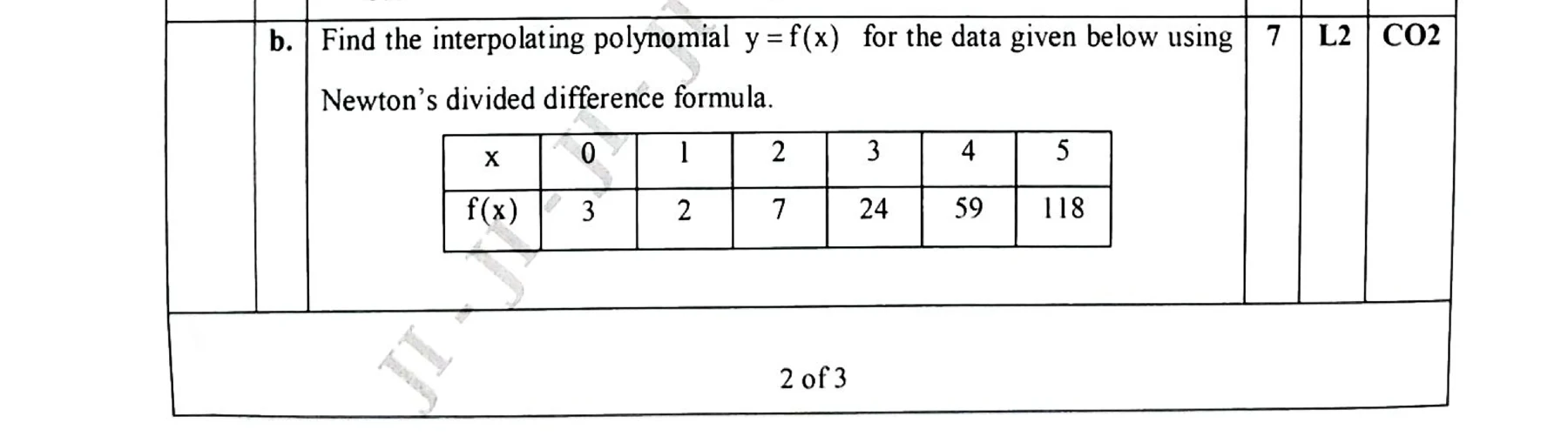
Find the interpolating polynomial y = f(x) for the data given below using
Newton's divided difference formula.
1
f(х) 3 2 7 24 59 118
IBMATC201
OCR transcription · Wording, symbols, or figures may be incomplete.
View question scan & diagrams1 exam session
June/July 2026 · PDF page 2
Show 2 Backup Questions
Using Lagrange's interpolation formula, find the interpolating polynomial
that approximates the function described by the following data and hence
OCR transcription · Wording, symbols, or figures may be incomplete.
View question scan & diagrams1 exam session
June/July 2026 · PDF page 3
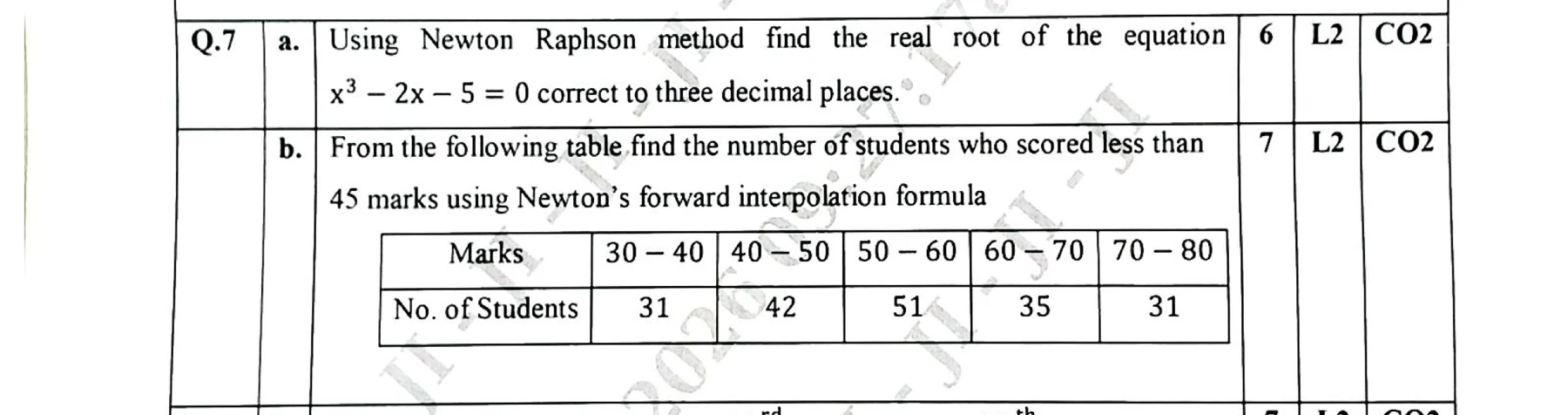
Using Newton Raphson method find the real root of the equation
x3 - 2x - 5 = 0 correct to three decimal places.
From the following table find the number of students who scored less than
45 marks using Newton's forward interpolation formula
Marks 30 - 40 40 - 50 50 - 60 60 - 70 70 -
No. of Students
OCR transcription · Wording, symbols, or figures may be incomplete.
View question scan & diagrams1 exam session
June/July 2026 · PDF page 2
Module 5
Employ Taylor series method to find an approximate solution to find y at | 6 L2 |
x = 0.1 given dx = x - y½,y(0) = 1 by considering upto fourth degree
term.
OCR transcription · Wording, symbols, or figures may be incomplete.
View question scan & diagrams1 exam session
June/July 2026 · PDF page 3
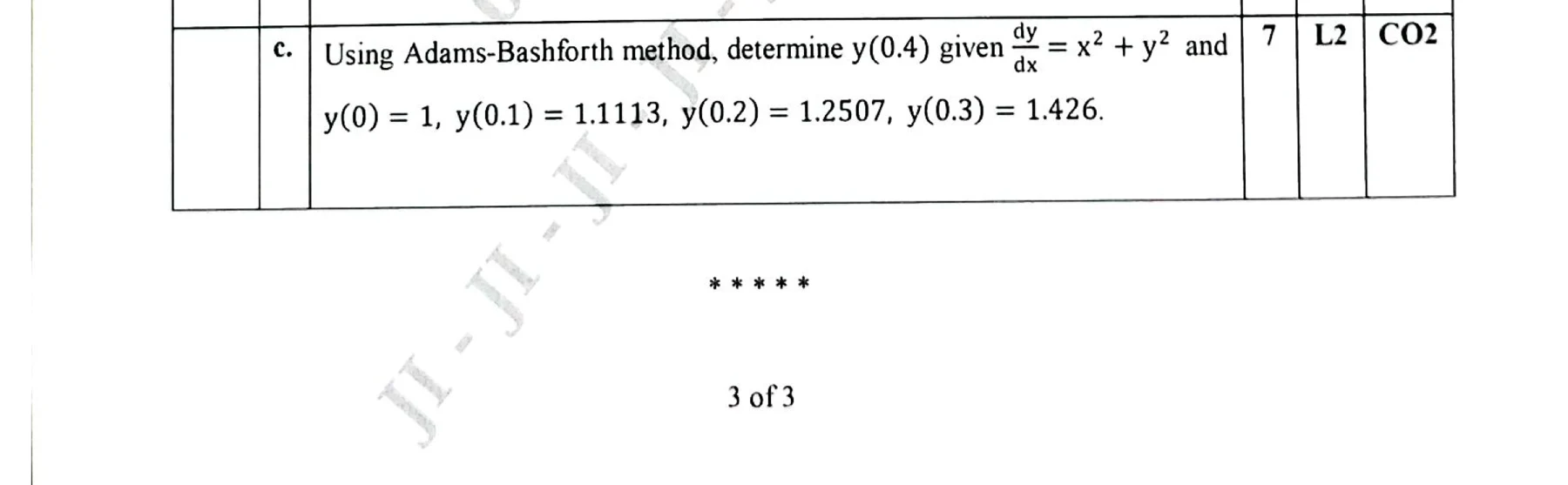
Using Adams-Bashforth method, determine y (0.4) given y = x + y2 and
у(0) = 1, у(0.1) = 1.1113, у(0.2) = 1.2507, у(0.3) = 1.426.
OCR transcription · Wording, symbols, or figures may be incomplete.
View question scan & diagrams1 exam session
June/July 2026 · PDF page 3
Using Euler's modified method, find y at x = 0.1 given " = y-x У+x'У(O) =
by taking h = 0.1
OCR transcription · Wording, symbols, or figures may be incomplete.
View question scan & diagrams1 exam session
June/July 2026 · PDF page 3
Show 2 Backup Questions
Using Runge - Kutta method of fourth order, compute y(1.1) given that
dy = xy3, y(1) = 1 by taking h = 0.1
OCR transcription · Wording, symbols, or figures may be incomplete.
View question scan & diagrams1 exam session
June/July 2026 · PDF page 3
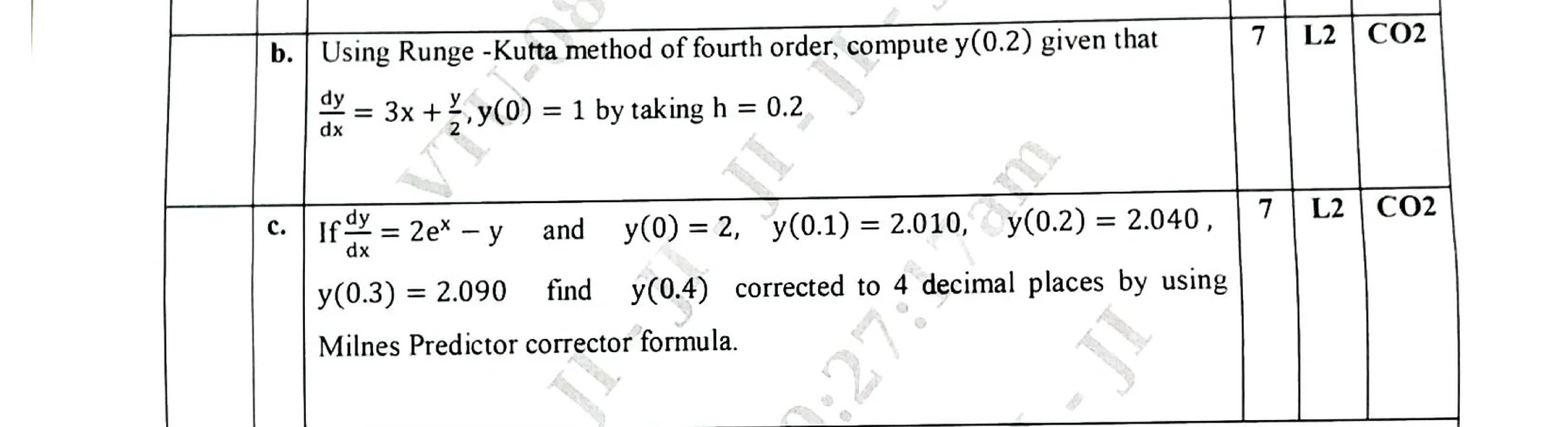
Using Runge -Kutta method of fourth order, compute y(0.2) given that
y = 3x +·, y(0) = 1 by taking h = 0.2
If-y = 2e* - y and y(0) = 2, y(0.1) = 2.010, y(0.2) = 2.040,
y(0.3) = 2.090 find y(0.4) corrected to 4 decimal places by using
Milnes Predictor corrector formula.
OCR transcription · Wording, symbols, or figures may be incomplete.