Similar question wording is grouped and ranked by the number of distinct exam sessions. Groups with the same count are ordered by their extracted text. Some subjects have only one session. Paper references show the PDF page and extracted question number when available.
Module 1
Define Corrosion Penétration Rate (CPR). A steel plate (density = 7.9
g/cm') of aréa 120 in? was exposed to a marine environment for 18 months
and experienced a weight loss of 420 g. Calculate the CPR in: (a) mpy
(b) mm/yeat. (Given: K = 534 for mpy, K = 87.6 for mm/y).
OCR transcription · Wording, symbols, or figures may be incomplete.
View question scan & diagrams1 exam session
June/July 2026 · PDF page 1
Discuss electrochemical theory of corrosion by taking Fe as an example.
OCR transcription · Wording, symbols, or figures may be incomplete.
View question scan & diagrams1 exam session
June/July 2026 · PDF page 1
Distinguish between differential metal corrosion and differențial aeration
corrosion with one suitable example.
OCR transcription · Wording, symbols, or figures may be incomplete.
View question scan & diagrams1 exam session
June/July 2026 · PDF page 1
Show 2 Backup Questions
Explain the anodization process as a surface conversion coating technique
for corrosion control. What are its advantages over conventional painting?
OCR transcription · Wording, symbols, or figures may be incomplete.
View question scan & diagrams1 exam session
June/July 2026 · PDF page 1
Explain the sacrificial anode method of cathodic protection for corrosion
control. Mention their applications in engineering.
OCR transcription · Wording, symbols, or figures may be incomplete.
View question scan & diagrams1 exam session
June/July 2026 · PDF page 1
Module 2
0.85 g of a coal sample containing 3.0% hydrogen was subjected to
combustion in a bomb calorimeter. The mass of water in the calorimeter
was 1200 g and the water equivalent of the calorimeter was 400 g. The rise
in temperature was 2.6°C. Calculate the GCV and NCV of the fuel.
(Specific heat of water = 4.2 kJ/kg°C; Latent heat of steam = 2454 kJ/kg)
OCR transcription · Wording, symbols, or figures may be incomplete.
View question scan & diagrams1 exam session
June/July 2026 · PDF page 2
Define octane and cetane numbers. Explain their significance in the
performance of petrol and diesel engines respectively.
OCR transcription · Wording, symbols, or figures may be incomplete.
View question scan & diagrams1 exam session
June/July 2026 · PDF page 1
Explain hydrogen storage using metal hydrides and ammonia as chemical
hydrogen carriers. Discuss the advantages and limitations of each méthod.
OCR transcription · Wording, symbols, or figures may be incomplete.
View question scan & diagrams1 exam session
June/July 2026 · PDF page 2
Show 2 Backup Questions
What are anti-knocking agents? Explain the role of MTBE and ETBE as
anti-knocking agents.
OCR transcription · Wording, symbols, or figures may be incomplete.
View question scan & diagrams1 exam session
June/July 2026 · PDF page 1
What is biodiesel? Explain the synthesis of biodiesel by the
transesterification method with a neat reaction scheme. Mention its
applications as a green fuel.
OCR transcription · Wording, symbols, or figures may be incomplete.
View question scan & diagrams1 exam session
June/July 2026 · PDF page 1
Module 3
Explain the construction and working of a Li-ion battery with cell reactions
and neat diagram.
OCR transcription · Wording, symbols, or figures may be incomplete.
View question scan & diagrams1 exam session
June/July 2026 · PDF page 2
Explain the construction, working and applications of a Solid Oxide Fuel
Cell (SOFC). How does it differ from a battery?
and cycle life with example.
OCR transcription · Wording, symbols, or figures may be incomplete.
View question scan & diagrams1 exam session
June/July 2026 · PDF page 2
Explain the size-dependent properties of nanomaterials with respect to:
(i) surface area, fii), catalytic property, (iii) electrical conductivity, and
(iv) thermal condućtivity.
OCR transcription · Wording, symbols, or figures may be incomplete.
View question scan & diagrams1 exam session
June/July 2026 · PDF page 2
Show 2 Backup Questions
Explain the synthesis of TiOz nanoparticles by the sol-gel method. Discuss
its uses.
OCR transcription · Wording, symbols, or figures may be incomplete.
View question scan & diagrams1 exam session
June/July 2026 · PDF page 2
What is graphene? Explain the synthesis of graphene by the Chemical
Vapor Deposition (CVD) method. Mention its important engineering
applications.
OCR transcription · Wording, symbols, or figures may be incomplete.
View question scan & diagrams1 exam session
June/July 2026 · PDF page 2
Module 4
Explain the preparation of carbon fiber from Polyacrylonitrile (PAN).
Discuss the important industrial applications of carbon fiber in mechanical
engineering.
OCR transcription · Wording, symbols, or figures may be incomplete.
View question scan & diagrams1 exam session
June/July 2026 · PDF page 2
Explain the structure-properties relationship of polymers with reference to:
(1) crystallinity, (ii) strength, and (iii) elasticity.
OCR transcription · Wording, symbols, or figures may be incomplete.
View question scan & diagrams1 exam session
June/July 2026 · PDF page 2
Explain the synthesis, properties and engineering applications of
Polymethyl Methacrylate (PMMA). Why is it preferred over glass in many
applications?
OCR transcription · Wording, symbols, or figures may be incomplete.
View question scan & diagrams1 exam session
June/July 2026 · PDF page 3
Show 2 Backup Questions
In a polymer sample, 25% of molecules have molecular mass 8,000 g/mol;
45% have molecular mass 18,000 g/mol; and the remaining have molecular
mass 30,000 g/mol. Calculate the number average and weight average
molecular masses of the polymer.
OCR transcription · Wording, symbols, or figures may be incomplete.
View question scan & diagrams1 exam session
June/July 2026 · PDF page 2
What is a fiber-reinforced polymer (FRP)? Explain the synthesis of Keylar,
its important properties, and industrial applications in mechanical
engineering.
OCR transcription · Wording, symbols, or figures may be incomplete.
View question scan & diagrams1 exam session
June/July 2026 · PDF page 3
Module 5
Define coolants? Briefly classify coolants types. Explain their properties
and industrial applications in machining operations.
OCR transcription · Wording, symbols, or figures may be incomplete.
View question scan & diagrams1 exam session
June/July 2026 · PDF page 3
Describe the expérimental determination of viscosity coefficient of a
lubricant using, Ostwald's viscometer. Mention the significance of viscosity
in lubricant selection.
OCR transcription · Wording, symbols, or figures may be incomplete.
View question scan & diagrams1 exam session
June/July 2026 · PDF page 3
Explain the principle of a pH sensor (glass electrode) and its application in
the estimation of pKa of an acid electrolyte.
OCR transcription · Wording, symbols, or figures may be incomplete.
View question scan & diagrams1 exam session
June/July 2026 · PDF page 3
Show 2 Backup Questions
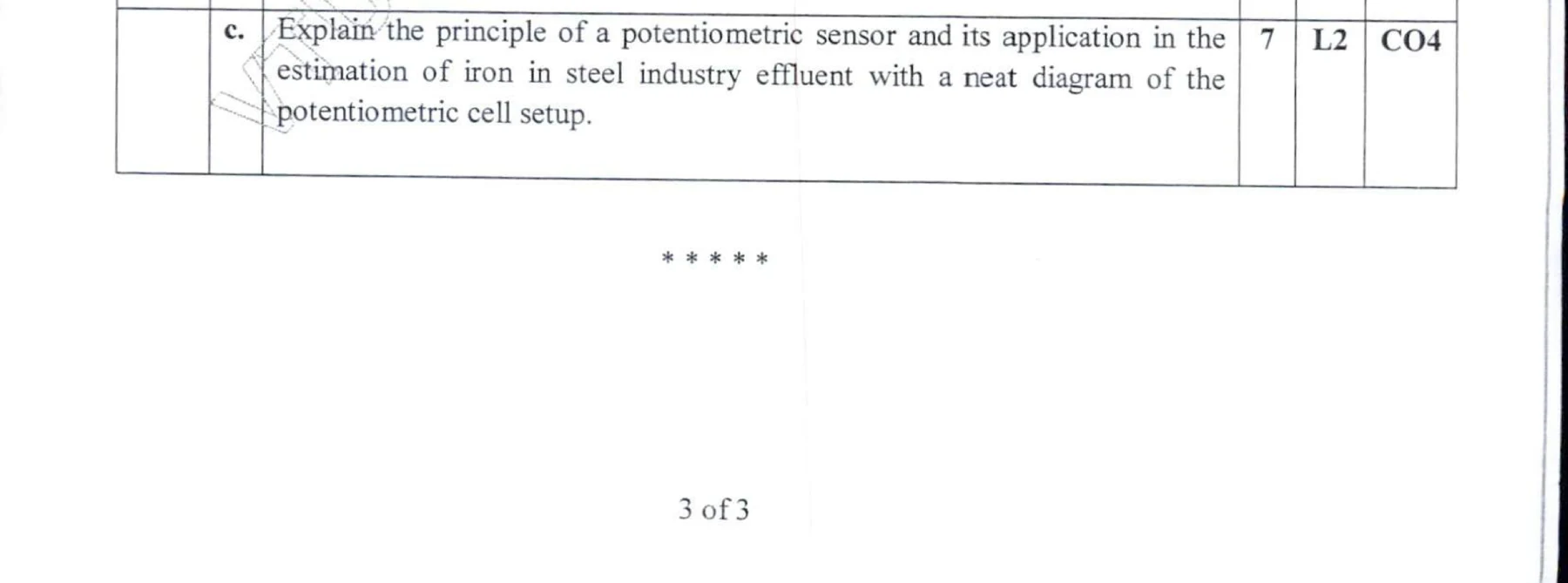
Explain the principle of a potentiometric sensor and its application in the
estimation of iron in steel industry effluent with a neat diagram of the
potentiometric cell setup.
OCR transcription · Wording, symbols, or figures may be incomplete.
View question scan & diagrams1 exam session
June/July 2026 · PDF page 3
for blank and sample titration respectively. The volume of the test sample
used is 25 cm'. Calculate the COD of the sample solution.
OCR transcription · Wording, symbols, or figures may be incomplete.