Similar question wording is grouped and ranked by the number of distinct exam sessions. Groups with the same count are ordered by their extracted text. Some subjects have only one session. Paper references show the PDF page and extracted question number when available.
Module 1
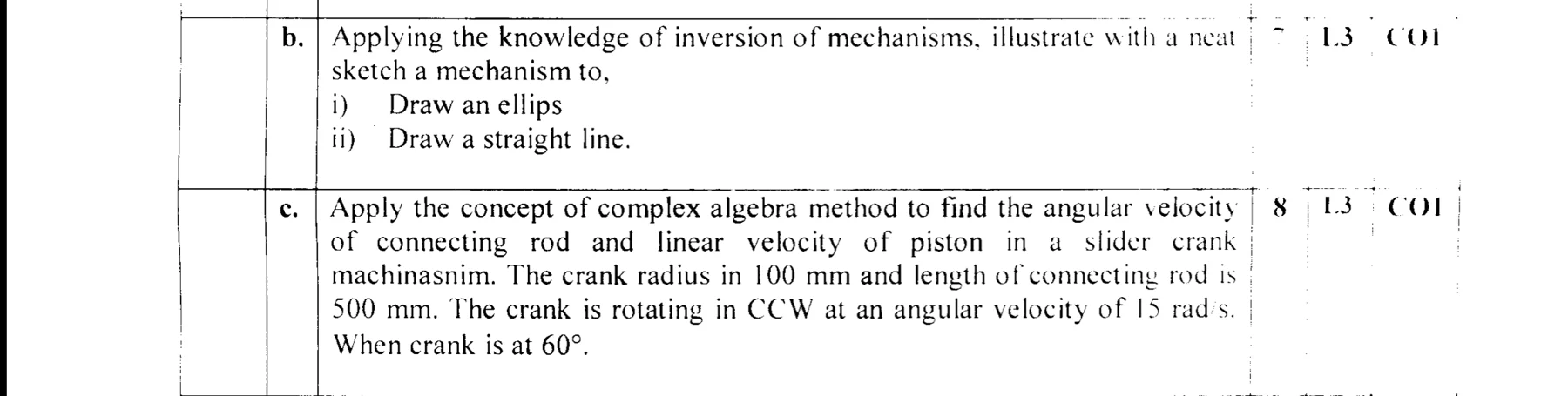
Applying the knowledge of inversion of mechanisms, illustrate with a neat
sketch a mechanism to,
1) Draw an ellips
ii) Draw a straight line.
Apply the concept of complex algebra method to find the angular velocity
of connecting rod and linear velocity of piston in a slider crank
machinasnim. The crank radius in 100 mm and length of connecting rod is
500 mm. The crank is rotating in CCW at an angular velocity of 15 rad s
When crank is at 60°.
OCR transcription · Wording, symbols, or figures may be incomplete.
View question scan & diagrams1 exam session
June-July-2025 · PDF page 1
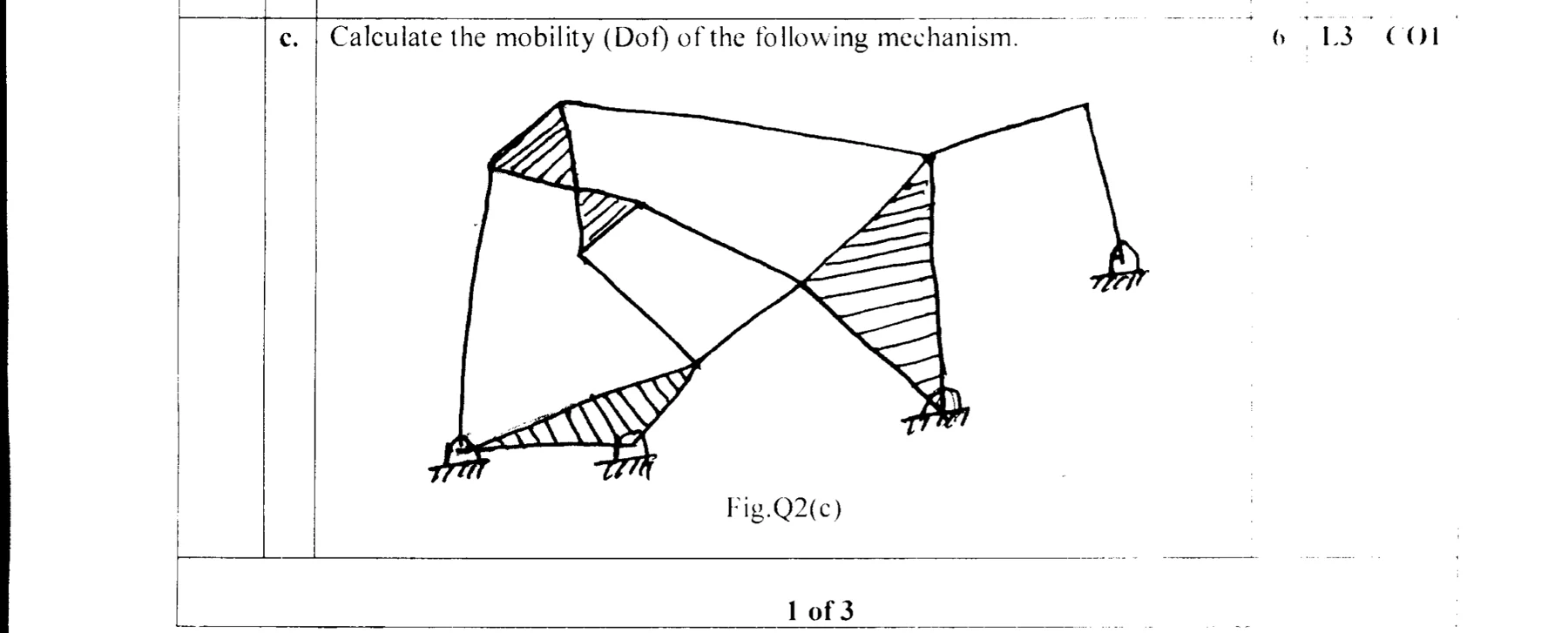
Calculate the mobility (Dof) of the following mechanism.
Fig.Q2(c)
1
BME503/BMR503
OCR transcription · Wording, symbols, or figures may be incomplete.
View question scan & diagrams1 exam session
June-July-2025 · PDF page 1
Classify kinematic pair based on relative motion.
OCR transcription · Wording, symbols, or figures may be incomplete.
View question scan & diagrams1 exam session
June-July-2025 · PDF page 1
Show 2 Backup Questions
Define degrees of freedom and mobility of mechanism.
OCR transcription · Wording, symbols, or figures may be incomplete.
OCR transcription · Wording, symbols, or figures may be incomplete.
View question scan & diagrams1 exam session
June-July-2025 · PDF page 1
Module 2
Analyse D'Alembert's principle for dynamic force analysis
OCR transcription · Wording, symbols, or figures may be incomplete.
View question scan & diagrams2 exam sessions
June-July-2025 · PDF page 2
Dec-2024-Jan-2025 · PDF page 2
A punching machine punches 38 mm holes in 32 mm thick plate requires
7 N-m/mm' of sheared area and punches one hole in every 10 sec. The
mean speed is of the flywheel given is 25 m/sec. The punch has a stroke of
100 mm. Find :
(i) Power required to drive the machine.
(ii) Mass of the flywheel, if total fluctuation of speed is not to exceed 3%.
OCR transcription · Wording, symbols, or figures may be incomplete.
View question scan & diagrams1 exam session
Dec-2024-Jan-2025 · PDF page 2
Analyze the static equilibrium of a member subjected to two force system.
three force system and two force and a torque.
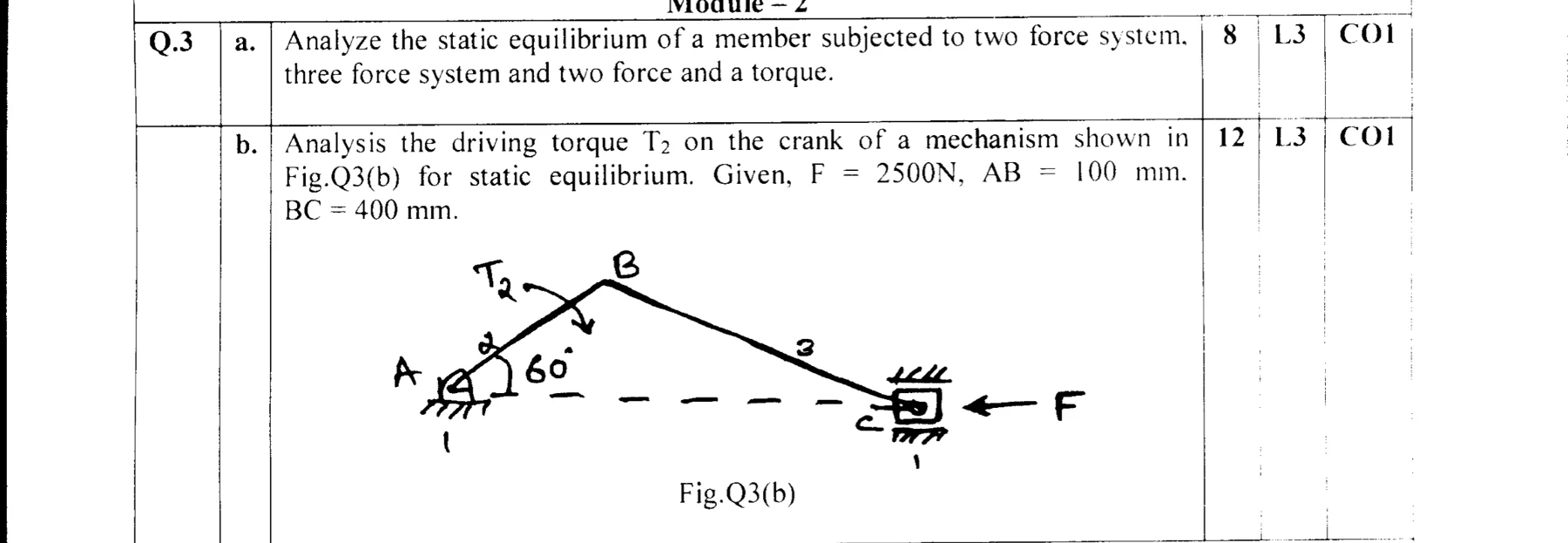
Analysis the driving torque T2 on the crank of a mechanism shown in
Fig.Q3(b) for static equilibrium. Given, F = 2500N, AB = 100 mm.
BC = 400 mm.
60
Fig.Q3(b)
OCR transcription · Wording, symbols, or figures may be incomplete.
View question scan & diagrams1 exam session
June-July-2025 · PDF page 2
Show 2 Backup Questions
Apply the concepts of dynamic force analysis to determine the inertia
forces of the 4-link mechanism. AB = 500 mm, BC = 660 m.
CD = 560 mm, and AD = 1000 mm, the link AB has an angular velocity of
10.5 rad/s CCW and an angular retardation of 26 rad/s' at the instant when
it makes an angle of 60° with AD, the fixed link. The mass of the links BC
and CD are 4.2 kg/m length. The link AB has a mass of 3.54 kg, the centre
of which lies at 200 mm from A and a moment of inertia of 88500 kg.mm?
OCR transcription · Wording, symbols, or figures may be incomplete.
View question scan & diagrams1 exam session
June-July-2025 · PDF page 2
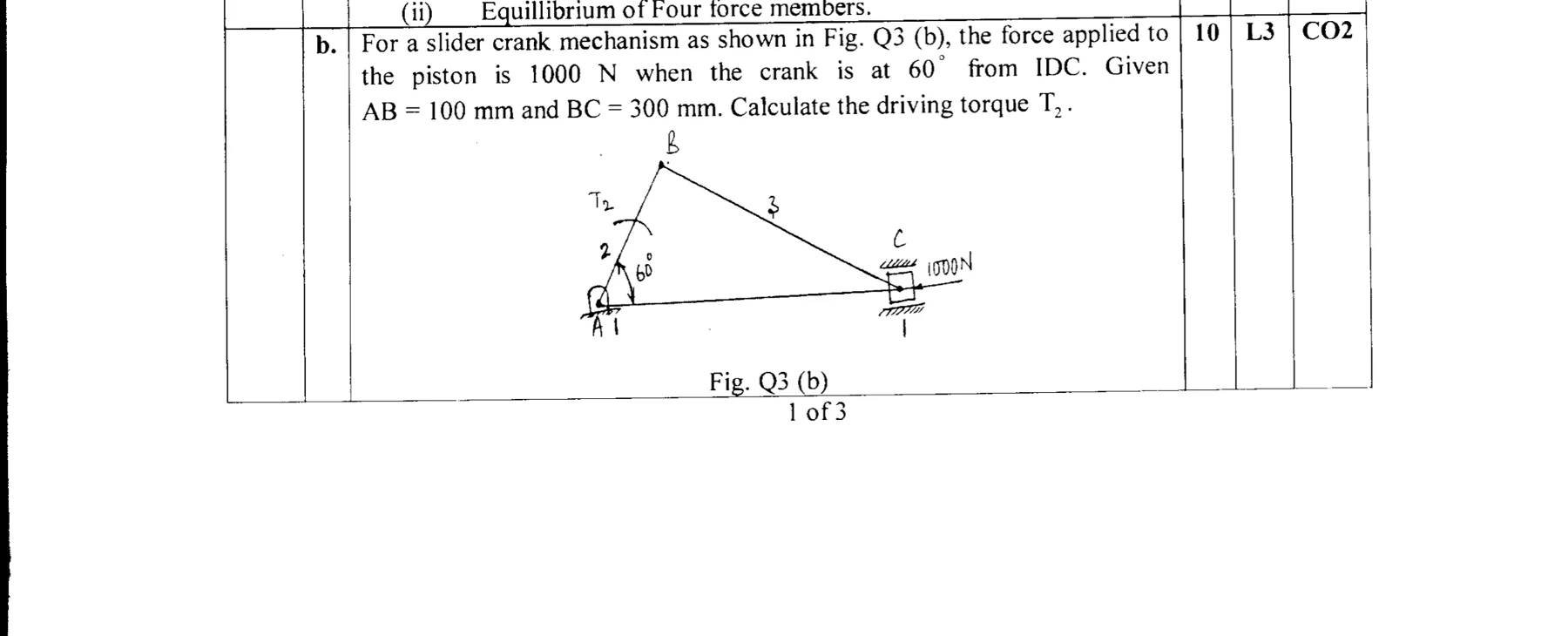
For a slider crank mechanism as shown in Fig. Q3 (b), the torce applied to
the piston is 1000 N when the crank is at 60° from IDC. Given
AB = 100 mm and BC = 300 mm. Calculate the driving torque T2.
М 100-
Fig. Q3 (b)
OCR transcription · Wording, symbols, or figures may be incomplete.
View question scan & diagrams1 exam session
Dec-2024-Jan-2025 · PDF page 1
Module 3
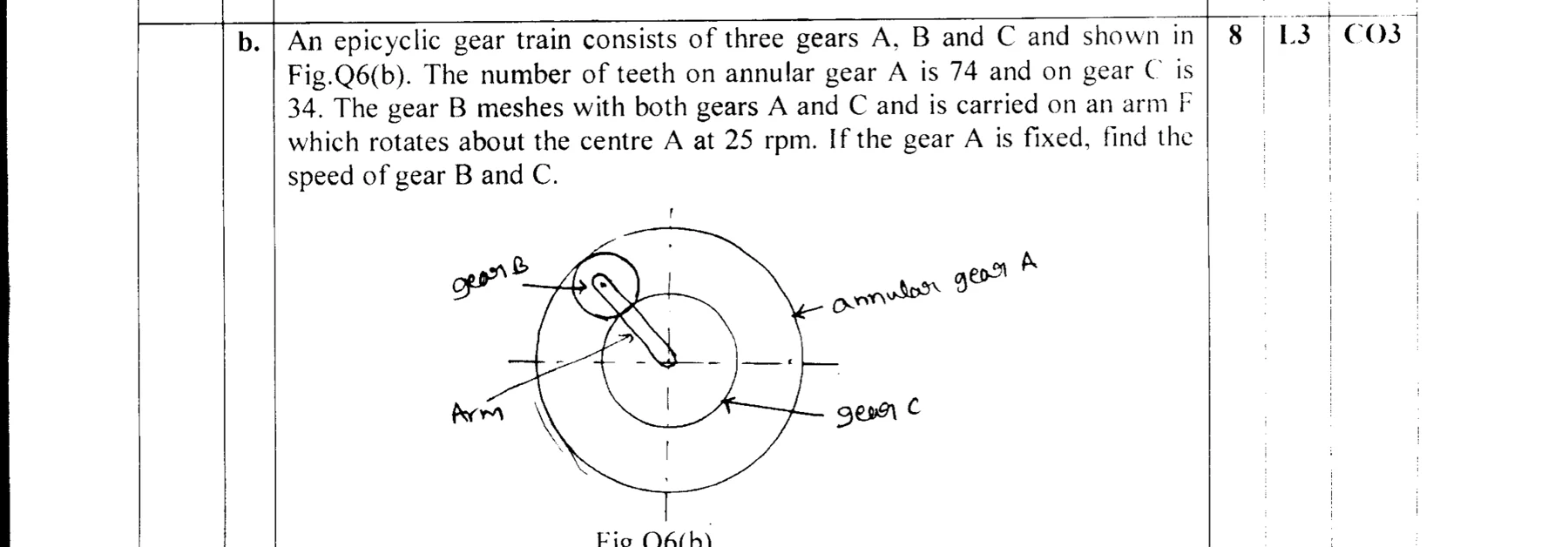
An epicyclic gear train consists of three gears A, B and C and shown in
Fig.Q6(b). The number of teeth on annular gear A is 74 and on gear C is
34. The gear B meshes with both gears A and C and is carried on an arm F
which rotates about the centre A at 25 rpm. If the gear A is fixed, find the
speed of gear B and C.
gear B - amnular gear A
Arm gear ćął
Fig.Q6(b)
OCR transcription · Wording, symbols, or figures may be incomplete.
View question scan & diagrams1 exam session
June-July-2025 · PDF page 2
Define the following gear terminologies
() Pitch circle.
(ii) Pitch circle diameter.
(i1) Addendum
Dedendum
OCR transcription · Wording, symbols, or figures may be incomplete.
View question scan & diagrams1 exam session
Dec-2024-Jan-2025 · PDF page 2
Explain with a neat sketch law of gearing
OCR transcription · Wording, symbols, or figures may be incomplete.
View question scan & diagrams1 exam session
June-July-2025 · PDF page 2
Show 2 Backup Questions
Two gear wheels of module pitch 4.5 mm have 24 and 33 teeth
respectively. Pressure angle 20°, each wheels has a standard addendum of
OCR transcription · Wording, symbols, or figures may be incomplete.
View question scan & diagrams1 exam session
June-July-2025 · PDF page 2
What is a gear train? Explain with a neat sketch any 3 types of gear train.
OCR transcription · Wording, symbols, or figures may be incomplete.
View question scan & diagrams1 exam session
June-July-2025 · PDF page 2
Module 4
A Porter governor has equal arms each of 250 mm long and pivoted on the
axis of rotation. Each flyball has a mass of 5 kg and the mass of central
sleeve is 15 kg. The radius of rotation of the flyball is 150 mm when the
governor begins to lift and 200 mm when the governor is at maximum
speed. Find the minimum, maximum speeds and the range of speed of the
governor.
OCR transcription · Wording, symbols, or figures may be incomplete.
View question scan & diagrams2 exam sessions
Dec-2024-Jan-2025 · PDF page 3
June-July-2025 · PDF page 3
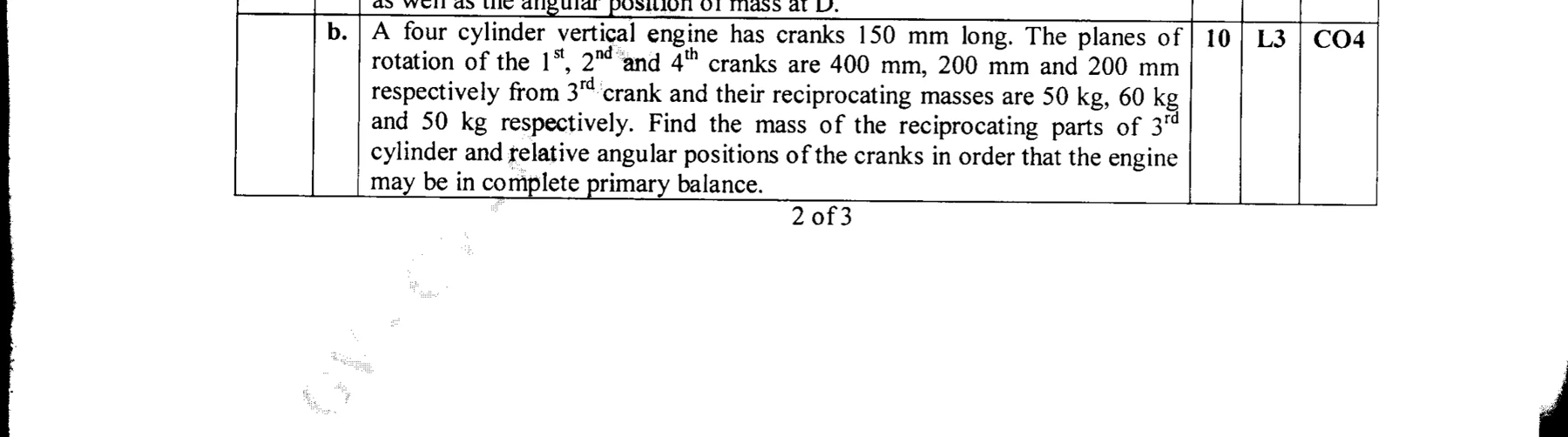
A four cylinder vertical engine has cranks 150 mm long. The planes of
rotation of the 1s ", 2nd and 4"h cranks are 400 mm, 200 mm and 200 mm
respectively from 3 crank and their reciprocating masses are 50 kg, 60 kg
and SU kg respectively. Find the mass of the reciprocating parts of 3r
cylinder and relative angular positions of the cranks in order that the engine
may be in complete primary balance.
OCR transcription · Wording, symbols, or figures may be incomplete.
View question scan & diagrams1 exam session
Dec-2024-Jan-2025 · PDF page 2
A pinion having 30 teeth drives a gear having 80 teeth. The profile of the
gears is involute with 20° pressure angle, 12 mm module and 10 mm
addendum. Find the length of path of contact and length of arc of contact.
OCR transcription · Wording, symbols, or figures may be incomplete.
View question scan & diagrams1 exam session
Dec-2024-Jan-2025 · PDF page 2
Show 2 Backup Questions
A shaft carries 4 masses A, B, C, D in parallel planes in this order along its
length. The masses at B and C are 18 kg and 12.5 kg respectively. Each of
B and C has an eccentricity of 60 mm. The masses at A and D have an
eccentricity of 80 mm. The angle between B and C is 100° and in between
B and A is 190°, , both being measured in same direction. The axial distance
between A and B is 100 mm and in between B and C is 200 mm. For the
shaft to be in complete balance, determine magnitude of masses at A and D
as well as the angular position of mass at D
OCR transcription · Wording, symbols, or figures may be incomplete.
View question scan & diagrams1 exam session
Dec-2024-Jan-2025 · PDF page 2
d. What is static and dynamic balancing?
OCR transcription · Wording, symbols, or figures may be incomplete.
View question scan & diagrams1 exam session
June-July-2025 · PDF page 3
Module 5
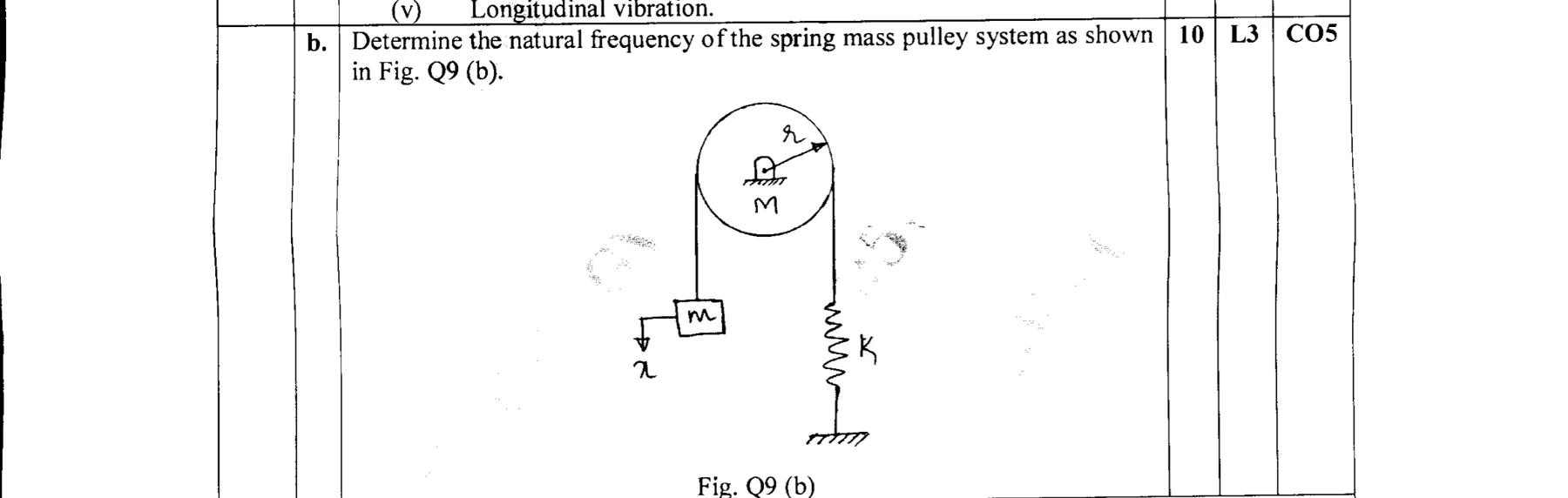
Determine the natural frequency of the spring mass pulley system as shown
in Fig. Q9 (b).
M
Fig. Q9 (b)
OCR transcription · Wording, symbols, or figures may be incomplete.
View question scan & diagrams2 exam sessions
Dec-2024-Jan-2025 · PDF page 3
June-July-2025 · PDF page 3
Define the following types of vibrations :
(i) Free vibration.
(i1) Forced vibration
(iii) Damped vibration.
(iv) Undamped vibration
(V) Longitudinal vibration.
OCR transcription · Wording, symbols, or figures may be incomplete.
View question scan & diagrams1 exam session
Dec-2024-Jan-2025 · PDF page 3
Explain the following :
Rotating unbalance.
Reciprocating unbalance.
Vibration isolation
d. Critical speed.
OCR transcription · Wording, symbols, or figures may be incomplete.
View question scan & diagrams1 exam session
Dec-2024-Jan-2025 · PDF page 3
Show 2 Backup Questions
With usual notations, determine the natural frequency of a simple
pendulum by neglecting the mass of the rod.
OCR transcription · Wording, symbols, or figures may be incomplete.
View question scan & diagrams1 exam session
June-July-2025 · PDF page 3
Write a note on :
i) Vibration isolation
ii) Critical speed.
OCR transcription · Wording, symbols, or figures may be incomplete.