Automated PYQ shortlist · Academic review pending. Questions are displayed from OCR. Some formulas and figures may need review.
Review status & sources
Similar question wording is grouped and ranked by the number of distinct exam sessions. Groups with the same count are ordered by their extracted text. Some subjects have only one session. Paper references show the PDF page and extracted question number when available.
Module 1
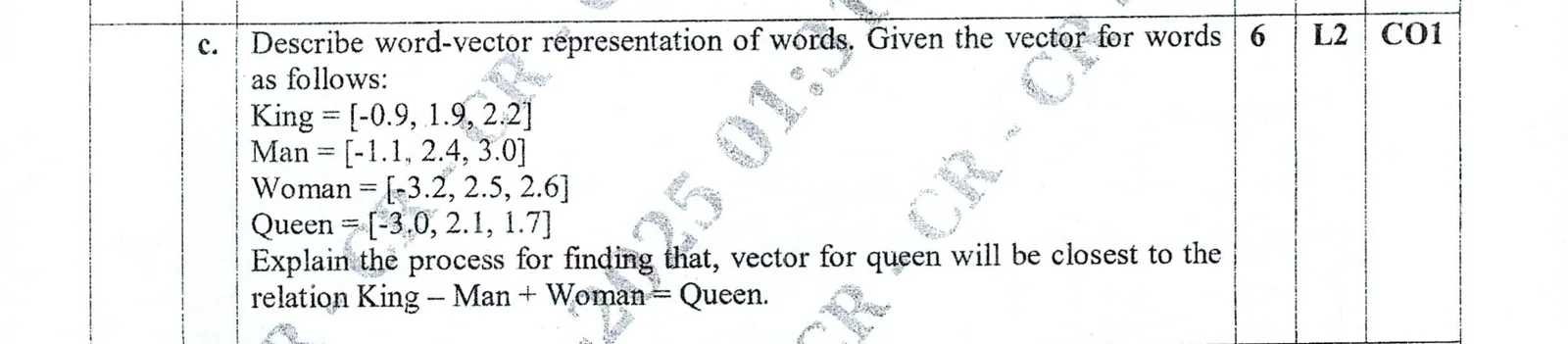
Describe word-vector representation of words. Given the vector for words
as follows:
King = [-0.9, 1.9, 2:2]
Man = [-1.1, 2.4, 3.0]
Woman = [-3.2, 2.5, 2.6]
Queen = [-3,0, 2.1, 1.7]
Explain the process for finding that, vector for queen will be closest to the
relation King - Man + Woman - Queen.
OCR transcription · Wording, symbols, or figures may be incomplete.
View question scan & diagrams1 exam session
Dec-2025-Jan-2026 · PDF page 1
Explain AlexNet's hierarchical architecture and its use in face detection.
OCR transcription · Wording, symbols, or figures may be incomplete.
View question scan & diagrams1 exam session
Dec-2025-Jan-2026 · PDF page 1
Explain how deep learning is used in natural language processing
application.
OCR transcription · Wording, symbols, or figures may be incomplete.
View question scan & diagrams1 exam session
June-July-2026 · PDF page 1
Show 2 Backup Questions
Explain how deep learning models reduce the need for manual feature
extraction methods like one-hot encoding in NLP.
OCR transcription · Wording, symbols, or figures may be incomplete.
View question scan & diagrams1 exam session
June-July-2026 · PDF page 1
Explain how the correctness of the sentence "The program impeccably
translated the textẠạiis determined using traditional learning and deep
learning representations.
OCR transcription · Wording, symbols, or figures may be incomplete.
View question scan & diagrams1 exam session
Dec-2025-Jan-2026 · PDF page 1
Module 2
Differentiate between Batch Gradient Descent and Minibatch Gradient
Descent.
OCR transcription · Wording, symbols, or figures may be incomplete.
View question scan & diagrams2 exam sessions
Dec-2025-Jan-2026 · PDF page 1
June-July-2026 · PDF page 1
Describe the concept of early stopping in model training and explain how it
works using an algorithm approaches.
OCR transcription · Wording, symbols, or figures may be incomplete.
View question scan & diagrams1 exam session
June-July-2026 · PDF page 1
Describe the key mechanics of the Adam Optimization Algorithm.
OCR transcription · Wording, symbols, or figures may be incomplete.
View question scan & diagrams1 exam session
Dec-2025-Jan-2026 · PDF page 1
Show 2 Backup Questions
Describe the purpose of regularization and'explain how L2 regularization
works compared to LI.
OCR transcription · Wording, symbols, or figures may be incomplete.
View question scan & diagrams1 exam session
June-July-2026 · PDF page 1
Explain how AdaGrad and RMSprop adjust the learning rate during
training and describe the key difference between their approaches.
OCR transcription · Wording, symbols, or figures may be incomplete.
View question scan & diagrams1 exam session
June-July-2026 · PDF page 1
Module 3
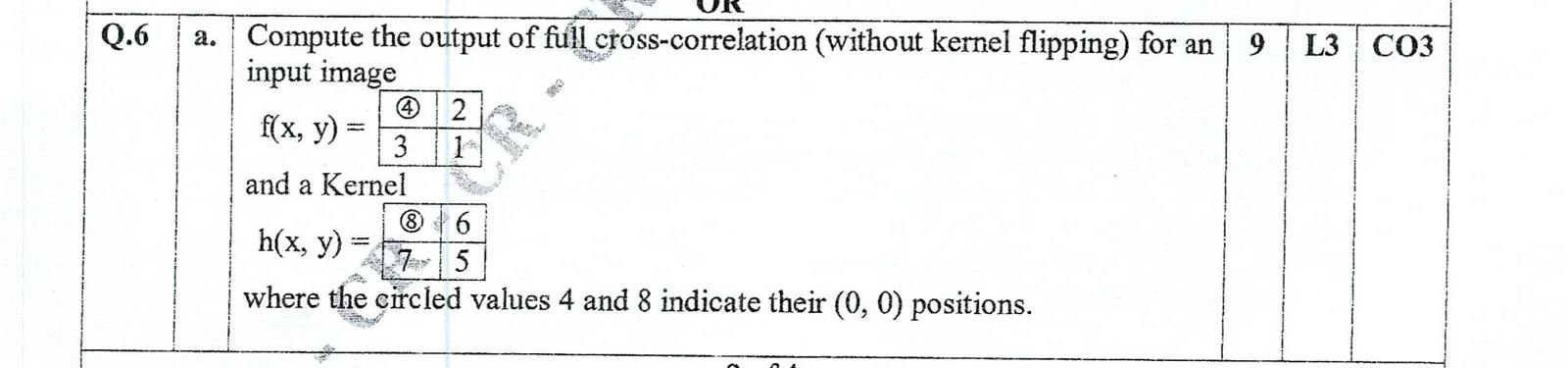
Compute the output of full cross-correlation (without kernel flipping) for an
input image
2
f(x, у) =
and a Kernel
6
h(x, y) =
where the circled values 4 and 8 indicate their (0, 0) positions.
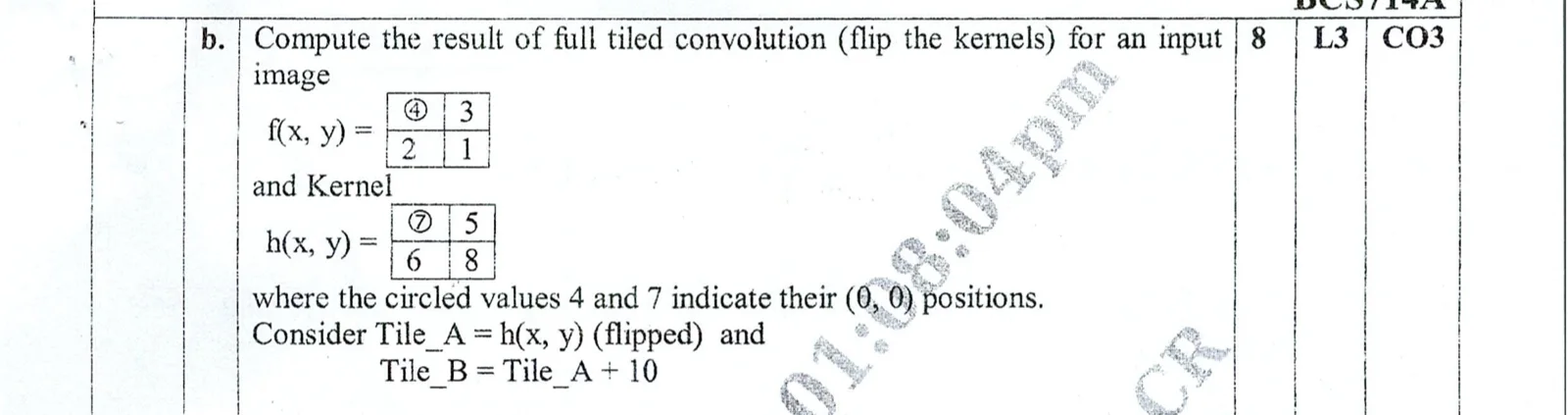
Compute the result of full tiled convolution (flip the kernels) for an input
image
3
f(x, y) =
and Kernel
5
h(x, y) =
where the circled values 4 and 7 indicate their (0, 0) positions.
Consider Tile_A = h(x, y) (flipped) and
Tile B = Tile_A +
OCR transcription · Wording, symbols, or figures may be incomplete.
View question scan & diagrams1 exam session
Dec-2025-Jan-2026 · PDF page 1
Describe how the convolution operation works in a convolution Neural
Network and explain its purpose in feature extraction.
Apply your understanding of sparse interactions, parameter sharing, and
equivariant representations to explain how convolution improves the
performance of image recognition models.
OCR transcription · Wording, symbols, or figures may be incomplete.
View question scan & diagrams1 exam session
June-July-2026 · PDF page 1
Describe the main components of a CNN layer and explain how each one
contributes to processing input data.
Apply your understanding of CNNs to identify and handle different input
data formats in a real - world application.
OCR transcription · Wording, symbols, or figures may be incomplete.
View question scan & diagrams1 exam session
June-July-2026 · PDF page 2
Show 2 Backup Questions
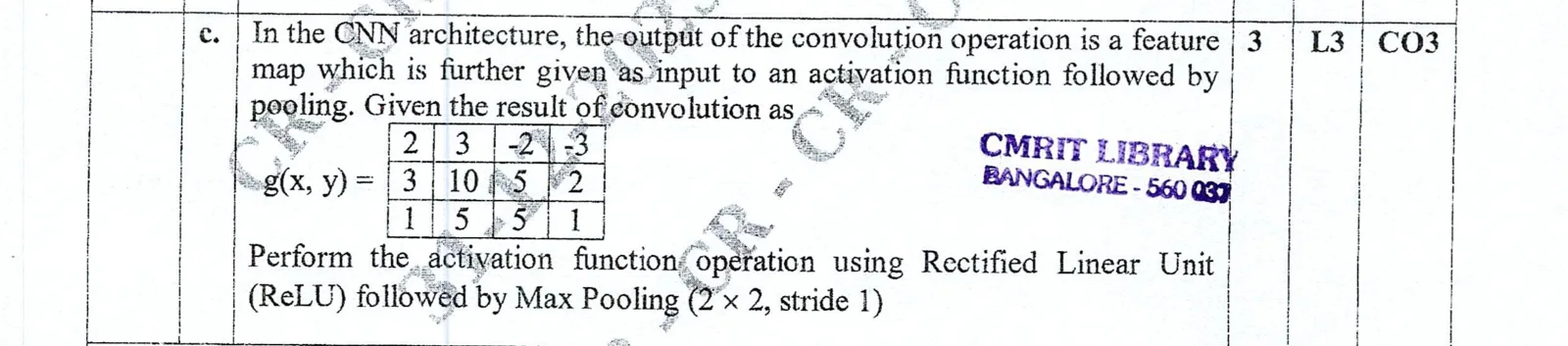
In the CNN architecture, the output of the convolution operation is a feature
map which is further given as input to an activation function followed by
pooling. Given the result of convolution as
5
Perform the activation function operation using Rectified Linear Unit
(ReLU) followed by Max Pooling (2 x 2, stride 1)
OCR transcription · Wording, symbols, or figures may be incomplete.
View question scan & diagrams1 exam session
Dec-2025-Jan-2026 · PDF page 1
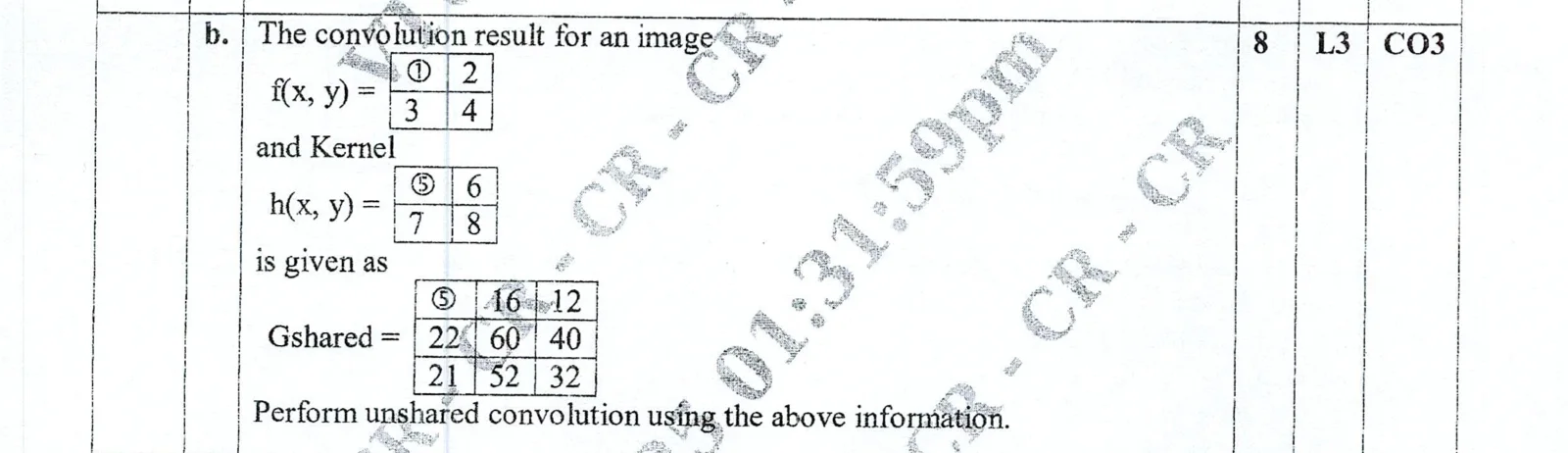
The convolution result for an image
O
f(x, y) =
and Kernel
6
h(x, y) =
is given as
16 112
Gshared =
21 52 |
Perform unshared convolution using the above information.
OCR transcription · Wording, symbols, or figures may be incomplete.
View question scan & diagrams1 exam session
Dec-2025-Jan-2026 · PDF page 1
Module 4
Apply your understanding of Recursive Neural Networks to design model
relationship in tree structural data.
OCR transcription · Wording, symbols, or figures may be incomplete.
View question scan & diagrams1 exam session
June-July-2026 · PDF page 2
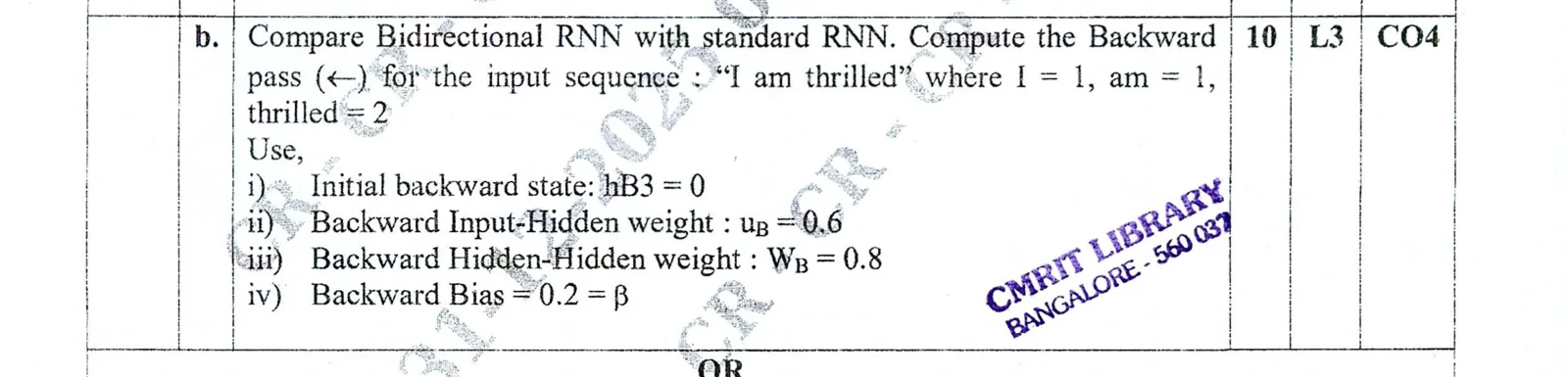
Compare Bidirectional RNN with standard RNN. Compute the Backward
pass (+) for the input sequence :I am thrilledi whère 1 = 1, am = 1,
thrilled -
Use,
i) Initial backward state: hB3 =
Backward Input-Hidden weight : uB -0.6
Backward Bias = 0.2 = ß
OCR transcription · Wording, symbols, or figures may be incomplete.
View question scan & diagrams1 exam session
Dec-2025-Jan-2026 · PDF page 2
Compare Deep Recurrent Networks and Recursive Neural Networks.
Represent the below provided input sentence: "I study Deep Learning" as a
tree using Recursive Network concept.
OCR transcription · Wording, symbols, or figures may be incomplete.
View question scan & diagrams1 exam session
Dec-2025-Jan-2026 · PDF page 2
Show 2 Backup Questions
Describe the roles of encoder and decoder in RNN encoder-decoder
architectures. Assume that the final encoder state h3 for the input sentence :
I play cricket = 0.937. If the classification weights per class for the classes
[learning, sports, others] is given by wy = [Wi, W2, w3] = [0.5, 1.5, -0.5] and
classification biases per class are given as by = [b1, b2, b3] = [0.0, -0.9, 0.0],
then decode the input sequence to the class "sports"
OCR transcription · Wording, symbols, or figures may be incomplete.
View question scan & diagrams1 exam session
Dec-2025-Jan-2026 · PDF page 2
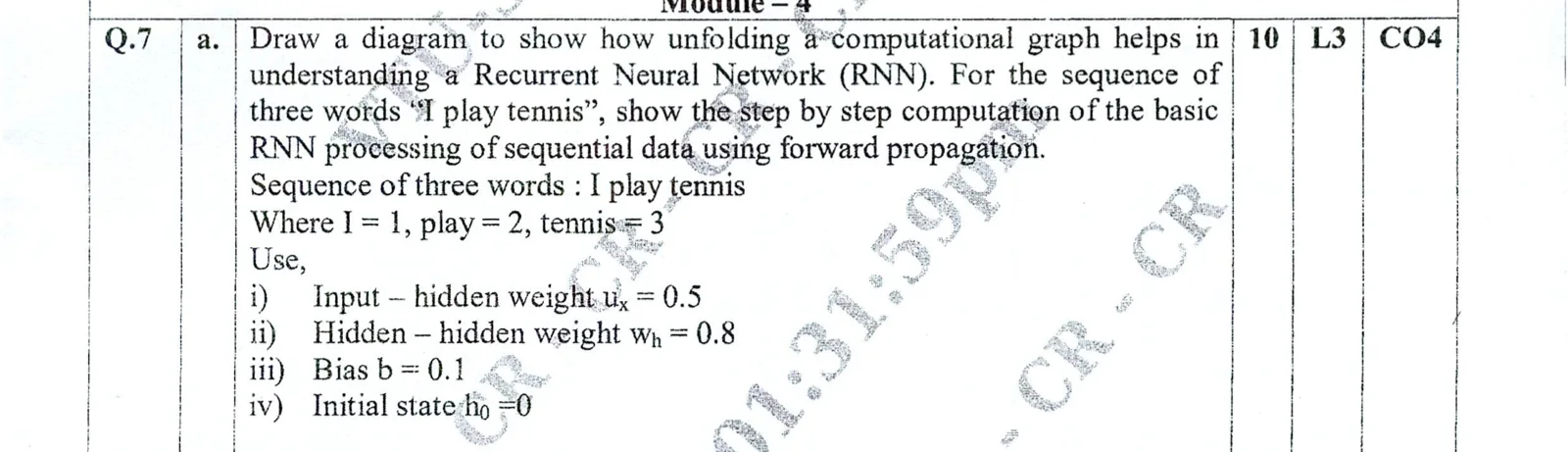
Draw a diagram to show how unfolding a čomputational graph helps in
understanding a Recurrent Neural Network (RNN). For the sequence of
three words "I play tennis" ', show the step by step computation of the basic
RNN processing of sequential data using forward propagation.
Sequence of three words : I play tennis
Where I = 1, play = 2, tennis =
Use,
Input - hidden weight ux = 0.5
Hidden - hidden weight Wh = 0.8
iii) Bias b = 0.1
iv) Initial state ho
OCR transcription · Wording, symbols, or figures may be incomplete.
View question scan & diagrams1 exam session
Dec-2025-Jan-2026 · PDF page 2
Module 5
Explain how high dimensional word vectors are plotted to map them to two
or three dimensions.
OCR transcription · Wording, symbols, or figures may be incomplete.
View question scan & diagrams1 exam session
Dec-2025-Jan-2026 · PDF page 2
Explain the common steps involved in preprocessing natural language data.
OCR transcription · Wording, symbols, or figures may be incomplete.
View question scan & diagrams1 exam session
June-July-2026 · PDF page 2
Explain the following common natural language preprocessing steps:
ì) Stop word removal
ii) Stemming
OCR transcription · Wording, symbols, or figures may be incomplete.
View question scan & diagrams1 exam session
Dec-2025-Jan-2026 · PDF page 2
Show 2 Backup Questions
Explain the following performance metrics of deep learning NLP models:
1) The area under the ROC curve
OCR transcription · Wording, symbols, or figures may be incomplete.
View question scan & diagrams1 exam session
Dec-2025-Jan-2026 · PDF page 2
Explain with a toy example, how the ROC Auc metric is calculated.
VTU-31-12
CR - CR -CR - CR -C
31-12-2025 01:31:59pm
CR - CR
CR -CR - CR -CR - CR - CR - CR - CR
R -CR. 4 of4
OCR transcription · Wording, symbols, or figures may be incomplete.